
The earliest symptoms of a receding hairline are subtle enough that most men miss them for months or years. By the time recession is obvious in the mirror, significant miniaturization has already occurred. Knowing what to look for gives you the advantage of catching it when treatment is most effective.
The 7 Early Warning Signs
1. Uneven temple recession
A normal maturing hairline moves up evenly across the forehead. DHT-driven recession deepens at the temples first, creating an increasingly pronounced M-shape. Look at old photos of yourself from 1 to 2 years ago. If the temples have visibly deepened while the center has held steady, that's recession, not maturation.
2. Miniaturized hairs at the hairline edge
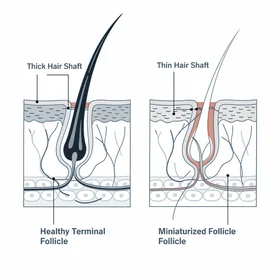
This is the most definitive early sign. Run your fingers along the edge of your hairline. If you feel fine, wispy, almost colorless hairs mixed in with normal terminal hairs, those are miniaturized follicles. They're in the process of shutting down under DHT exposure. A maturing hairline has a clean, sharp edge. A receding hairline has a fuzzy, indistinct border.
3. Increased hair in the drain or on the pillow
Losing 50 to 100 hairs per day is normal. But if you're consistently noticing more hair than usual in the shower drain, on your pillow, or when you run your hands through your hair, it may indicate accelerated shedding from DHT-driven miniaturization. Track it for 2 to 4 weeks before drawing conclusions, since shedding fluctuates seasonally.
4. Scalp visibility at the temples
In good overhead lighting, can you see more scalp at the temples than you used to? Thinning precedes recession. Before the hairline physically moves backward, the density of hair at the temples decreases. This is easiest to spot under harsh bathroom lighting or in direct sunlight.
5. Hair feels thinner when wet
Wet hair clumps together and reveals density more honestly than dry, styled hair. If your wet hairline looks noticeably thinner than it used to, or if you can see more scalp when your hair is wet than seems right, that's worth paying attention to.
6. Widening part line
While more associated with crown thinning than hairline recession specifically, a widening part can be an early indicator that DHT-driven miniaturization is happening across the scalp, including at the hairline. If your part looks wider than a year ago, the same process is likely affecting your temples.
7. Family pattern recognition
Look at your father, maternal grandfather, and maternal uncles. If multiple men in your family show the same recession pattern you're beginning to see, that's a strong signal. Androgenetic alopecia is highly heritable. Genetic susceptibility doesn't guarantee the same timeline, but it confirms the mechanism.
Self-Assessment: Maturing vs. Receding
| Sign | Normal Maturing | DHT-Driven Recession |
|---|---|---|
| Temple shape | Even, slight rounding | Asymmetric, deepening V or M |
| Hairline edge | Clean, defined | Fuzzy with miniaturized hairs |
| Progression | Stabilizes by mid-20s | Continues over months/years |
| Crown involvement | None | Often concurrent thinning |
| Shedding | Normal (50-100/day) | Increased, especially after combing |
| Family history | Less relevant | Strong predictor |
What to Do If You See These Signs
If you check 3 or more of the warning signs above, it's worth taking action rather than waiting to see if it gets worse. Here's the practical next step:
- Document your baseline. Take clear photos of your hairline from the front, both temples, and top-down under consistent lighting. Repeat monthly. Your memory of how your hair looked is unreliable. Photos don't lie.
- Start a low-risk intervention. A natural DHT blocker like Procerin addresses the underlying mechanism with minimal downside. If it turns out your hairline is just maturing normally, you've lost nothing. If it's genuine recession, you've bought yourself time.
- See a dermatologist if uncertain. A dermoscopic exam can measure the ratio of terminal to miniaturized hairs and give you a definitive answer. This is especially worthwhile if you're in your early 20s and unsure whether what you're seeing is normal maturation or early pattern loss.
- Don't wait for certainty. The biggest mistake men make is waiting until recession is undeniable before acting. By that point, you've lost follicles that were saveable 2 years earlier. The cost of starting treatment you didn't strictly need is negligible. The cost of not starting treatment you did need is permanent.
For a complete look at your treatment options and what to expect at each stage, see our comparison guide. And for the full explanation of why DHT targets the hairline first, see our mechanism overview.